

- Best for MAP, unauthorized sellers, and IP in one system: Brand Alignment.
- Best for counterfeit takedowns at scale: Red Points.
- Best for phishing, impersonation, and digital risk: BrandShield.
- Best for security teams that manage brand risk as part of threat intelligence: ZeroFox.
- Best for automated MAP enforcement and Buy Box tracking: MetricsCart.
- Most brand protection software is priced by custom quote. Of these five, only MetricsCart publishes a starting price.
Table of Contents
- Quick Comparison
- Brand Alignment
- MetricsCart
- Red Points
- BrandShield
- ZeroFox
- How to Choose the Right Brand Protection Software
- What Features Should Brand Protection Software Have?
- Self-Serve vs. Managed Brand Protection
- How Much Does Brand Protection Software Cost?
- Frequently Asked Questions
- Final Thoughts

Quick Comparison
| Platform | Primary Focus | Delivery Model | Best For | Starting Price | Free Trial |
|---|---|---|---|---|---|
| Brand Alignment | Full-stack: MAP, unauthorized sellers, IP takedowns | Self-serve or fully managed | Brands with more than one of these problems at once | Custom quote | 7-day trial (MAP monitoring) |
| MetricsCart | MAP monitoring and automated enforcement across 150+ retailers | Software with personalized onboarding | Brands that want automated MAP enforcement and Buy Box tracking | From $300/month | Demo |
| Red Points | Counterfeit detection and takedowns at scale | Platform plus expert services | High-volume counterfeit removal across many marketplaces | Custom quote | Demo |
| BrandShield | Social media, phishing, and digital risk | Managed | Brands with impersonation and fraud problems beyond marketplaces | Custom quote | Demo |
| ZeroFox | Social, domain, and executive impersonation | Managed | Security teams that need brand protection inside a broader threat intelligence platform | Custom quote | Demo |
Brand Alignment
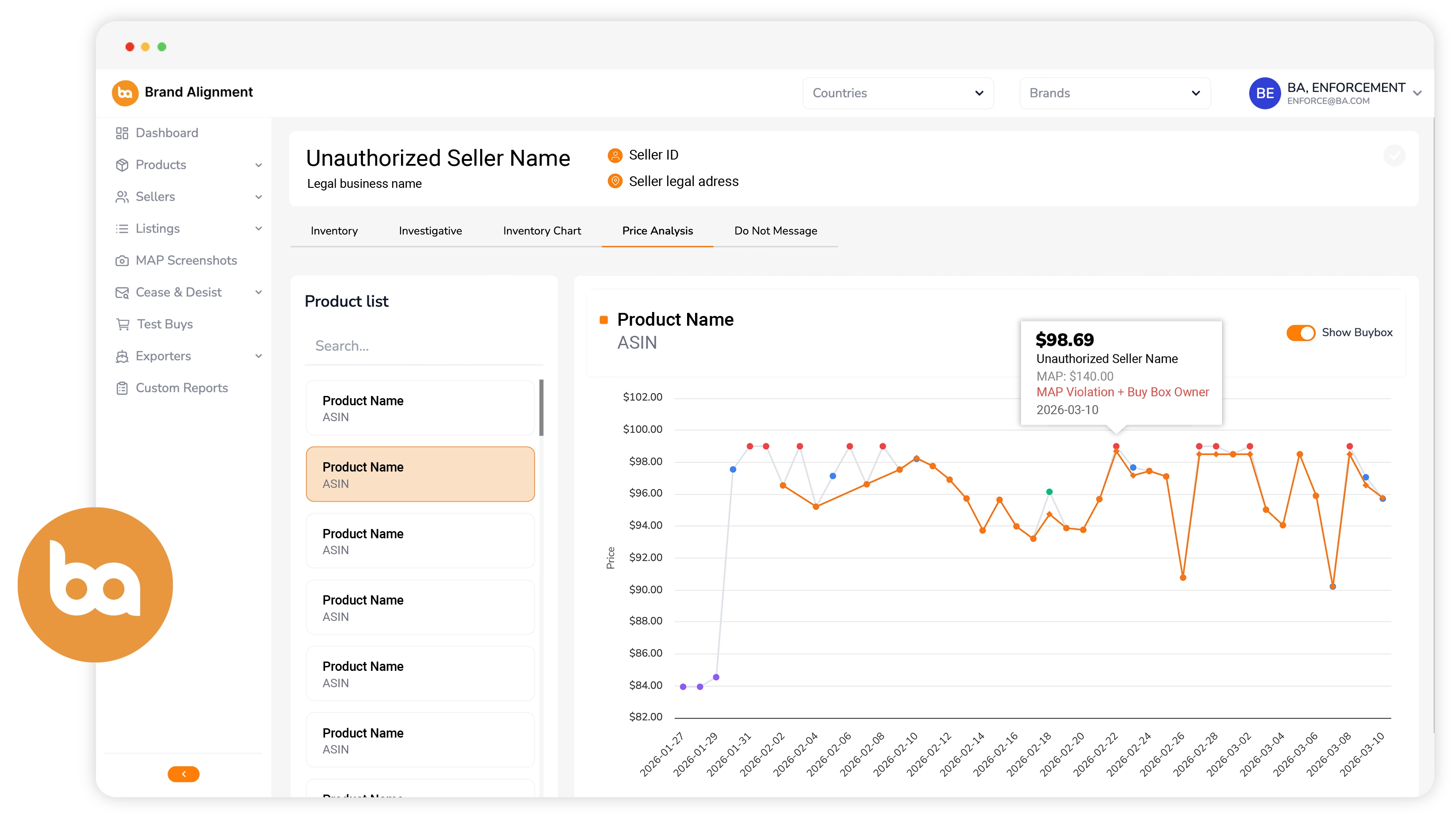
Brand Alignment is built around a different assumption than most of the platforms on this list: MAP violations, unauthorized sellers, and IP infringement usually don’t show up alone, so a brand shouldn’t need three separate vendors to handle them. All three are available as one system, or as standalone services if that’s all a brand needs right now.
Best for: brands selling on Amazon, Walmart, and other marketplaces that are dealing with price erosion, unauthorized resellers, and counterfeit or infringing listings at the same time.
What sets it apart in practice:
- 200+ marketplaces scanned every two hours, so price cascading gets caught the same day instead of a week later. Every violation comes with a timestamped screenshot.
- MAP enforcement with 98%+ compliance on Amazon and 95%+ on Walmart, through multi-step notices that the brand approves.
- Unauthorized seller removal rates of 98%+ on Amazon and 95%+ on Walmart, driven by sending a cease and desist to every seller found, not a sample.
- Trademark and copyright takedowns, including counterfeit listings.
- Self-serve or fully managed, the brand’s choice, not a fixed delivery model.
- Root-cause investigation that traces diverted product back into the supply chain instead of just removing today’s listing. See how seller investigations work.
Where it runs out of scope: Brand Alignment is built for marketplaces and ecommerce. It does not cover phishing sites, fake social profiles, or executive impersonation.
Pricing: custom quote. MAP monitoring software includes a 7-day free trial with no credit card required.
This is the most premium option on the list, and that’s by design. Brands choose it when they need more than automated alerts, they need enforcement that actually gets carried through, with a team behind it.
MetricsCart
MetricsCart is an enterprise-grade MAP monitoring and automated enforcement platform. It tracks pricing across 150+ online retailers and marketplaces to protect pricing integrity and margins, and pairs MAP compliance with digital shelf analytics such as share of search and ratings and reviews analysis.
Best for: brands that want automated MAP enforcement, Buy Box impact tracking, and published pricing in one tool.
Key capabilities:
- Continuous MAP monitoring and seller identification: separates authorized from unauthorized sellers, and compliant retail partners from violators.
- Automated evidence collection: captures and archives screenshot proof of each price breach, creating an audit trail for disputes.
- Automated tiered enforcement: pinpoints the violating seller accounts and triggers a structured, escalating MAP enforcement action plan.
- Buy Box and profitability tracking: tracks Buy Box wins and losses caused by pricing violations to measure the sales and margin impact.
- Compliance insights: flags recurring violation patterns, monitors newly launched products, and delivers MAP compliance and Buy Box reports.
Where it runs out of scope: MetricsCart is built around pricing compliance. It does not list counterfeit, trademark, or copyright takedowns, or impersonation outside marketplaces, so brands with IP problems will need a second vendor for that work.
Pricing: plans start at $300 per month for Starter (up to 50 SKUs) and $1,000 per month for Enterprise, with personalized onboarding included.
Red Points
Red Points built its reputation on counterfeit takedowns, and that’s still its core strength. It monitors marketplaces at scale and pushes infringing listings through takedown workflows, with reporting built around counterfeit detection specifically. Brands with heavy counterfeit exposure across dozens of marketplaces tend to reach for Red Points first.
Founded in 2014 and based in Barcelona, Red Points says it works with more than 1,300 brands and covers 200+ marketplaces, social media, websites, apps, and ads. It describes its pricing as a flat fee with unlimited detection and takedowns.
Best for: brands with heavy counterfeit exposure across many marketplaces and countries.
Where it runs out of scope: Red Points is not built around MAP enforcement as a primary function, so brands whose main problem is price erosion rather than fakes usually need to pair it with something else.
Pricing: custom quote.
BrandShield
BrandShield’s strength is breadth outside the marketplace itself: phishing sites, fake social profiles, lookalike domains, and impersonation across channels most brand protection tools don’t touch. It markets itself as covering the widest surface area of any platform on this list, websites, marketplaces, social, ads, apps, and the dark web, with AI-driven threat prioritization and a 24/7 security operations center handling enforcement.
Best for: brands whose biggest risk is fraud and impersonation that targets customers directly.
Where it runs out of scope: that breadth comes at the cost of marketplace-specific depth. A brand whose entire problem lives inside Amazon or Walmart listings may find more specialized tools do that narrower job better. It does not offer MAP monitoring or pricing enforcement.
Pricing: custom quote.
ZeroFox
ZeroFox sits at the intersection of brand protection and cybersecurity. It combines social media monitoring and executive impersonation protection with broader external threat intelligence, which makes it a natural fit for security teams managing brand risk as one part of a larger threat surface, not a standalone brand or marketing function.
Founded in 2013 and based in Baltimore, ZeroFox has been privately held since Haveli Investments acquired it in 2024. Its platform also covers phishing domains, dark web monitoring, and external attack surface management.
Best for: security teams that need brand protection inside a broader threat intelligence platform.
Where it runs out of scope: brands whose problem is specifically marketplace enforcement, MAP or unauthorized sellers, are outside ZeroFox’s core focus, which leans toward social and digital risk rather than ecommerce.
Pricing: custom quote.
How to Choose the Right Brand Protection Software
Start with the problem that is costing you the most money today, then check whether the platform also covers the next problem you’re likely to face.- If your main problem is counterfeits, look for high-volume detection and trademark and copyright takedowns across the marketplaces and countries where fakes appear.
- If your main problem is price erosion, look for frequent scans, screenshot evidence, and graduated enforcement. Our comparison of the top MAP monitoring software goes deeper on this category.
- If unauthorized sellers keep appearing on your listings, look for seller investigations and supply chain tracing, because a takedown request alone rarely removes a seller offering genuine products. See our list of unauthorized seller removal services.
- If fraud targets your customers directly, look for phishing, domain, and social media coverage with a fast takedown team.
- If you have more than one of these problems, count how many vendors you would need. Several tools mean several dashboards, contracts, and teams that don’t share data.
- How often do you scan, and does that change by plan?
- Which marketplaces, countries, and channels are covered today?
- What evidence comes with each violation?
- Who sends the notices and files the takedowns: my team, your software, or your staff?
- What happens when a seller ignores the first notice?
What Features Should Brand Protection Software Have?
At minimum, brand protection software should monitor the channels where your brand is sold or impersonated, report on what it found and what action was taken, and give you a way to take infringements down. For ecommerce brands, these features make the biggest difference:- Marketplace coverage that includes Amazon, Walmart, eBay, Google Shopping, and the other sites where your products are sold.
- Screenshot evidence with timestamps and seller details for every violation.
- Seller identification, so you know whether a seller is an authorized partner, an unauthorized reseller, or a counterfeiter. Each one needs a different response.
- Graduated enforcement, from a first notice to escalation, instead of one-off alerts.
- IP takedowns backed by registered rights, filed only when a listing meets the marketplace’s requirements.
- Buy Box visibility, because pricing problems and unauthorized sellers often show up first as lost Buy Box share. See our Buy Box Recovery Program.
Self-Serve vs. Managed Brand Protection
Self-serve software gives your team the dashboard, the evidence, and the templates, and your team does the enforcement. It costs less and fits brands with a clear, contained problem and someone with time to run it. A managed service adds a team that reviews violations, sends notices, escalates, and files takedowns for you. It costs more, and it fits brands where enforcement keeps slipping because nobody owns it day to day, or where problems need investigation and legal follow-through. On this list, Brand Alignment offers both models, including a managed MAP enforcement program. Red Points, BrandShield, and ZeroFox combine their platforms with expert or managed services. MetricsCart is software-first.How Much Does Brand Protection Software Cost?
Most brand protection platforms do not publish prices. Quotes usually depend on:- The number of products, SKUs, or ASINs you monitor
- The marketplaces, countries, and channels covered
- How often the platform scans
- Whether enforcement is self-serve or managed
- Whether you need IP takedowns, seller investigations, or test buys
Frequently Asked Questions
What is the best brand protection software in 2026?
Which brand protection software is best for Amazon sellers?
Which brand protection software is best for monitoring MAP violations?
Which brand protection platforms offer a fully managed service?
Can brand protection software remove unauthorized sellers?
What is the difference between brand protection software and MAP monitoring software?
Brand protection software is the broader category. It covers counterfeits, IP infringement, impersonation, and sometimes pricing. MAP monitoring software focuses on one problem: tracking advertised prices and flagging sellers below your Minimum Advertised Price. Some brand protection platforms include MAP monitoring, and some MAP tools include enforcement, but many do only one of the two.
How much does brand protection software cost?
Do brand protection platforms remove counterfeits automatically?
Is brand protection software only for large brands?
Final Thoughts
No two brand protection problems look exactly alike. The right platform is the one built for your specific combination of risk: MAP, unauthorized sellers, counterfeits, impersonation, or several at once. Talk to Brand Alignment to see exactly where your brand stands and which enforcement gaps are costing you the most.Take control of your marketplace presence with fast, effective brand protection strategies.
Every day, unauthorized sellers and MAP violations can erode your pricing, reputation, and revenue. Don’t wait for problems to escalate, start enforcing your policies and reclaim your market authority with our proven tools and expert support.


 Luis Amor